What Part of the Bible Do Jews Read
| Hebrew Bible | |
|---|---|
| תַּנַ״ךְ, Tanach | |
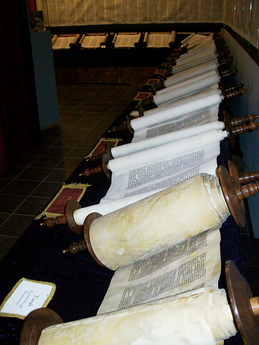 Complete gear up of scrolls, constituting the Tanakh | |
| Information | |
| Organized religion |
|
| Language |
|
| Period | 8th/7th centuries BCE – second/1st centuries BCE |
 Hebrew Bible at Hebrew Wikisource Hebrew Bible at Hebrew Wikisource | |
| | |

The Hebrew Bible or Tanakh [a] (;[ane] Hebrew: תַּנַ״ךְ, pronounced [taˈnaχ] or [təˈnax]) is the canonical collection of Hebrew scriptures, including the Torah, the Nevi'im, and the Ketuvim. These texts are about exclusively in Biblical Hebrew, with a few passages in Biblical Aramaic (in the books of Daniel and Ezra, the verse Jeremiah ten:11,[ii] and some single words).
The authoritative form of the Hebrew Bible for Rabbinic Judaism is the Masoretic Text (7th to tenth century CE), which consists of 24 books, divided into pesuqim (verses). The contents of the Hebrew Bible are similar to those of the Protestant Christian Sometime Testament, in which the material is divided into 39 books and arranged in a dissimilar guild. Catholic Bibles, Eastern / Greek Orthodox Bibles and Ethiopian Orthodox Bibles contain additional materials, derived from the Septuagint (texts translated into Koine Greek) and other sources.
In addition to the Masoretic Text, modern scholars seeking to understand the history of the Hebrew Bible employ a range of sources.[iii] These include the Septuagint, the Syriac linguistic communication Peshitta translation, the Samaritan Pentateuch, the Expressionless Ocean Scrolls collection and quotations from rabbinic manuscripts. These sources may exist older than the Masoretic Text in some cases and often differ from it.[iv] These differences have given rise to the theory that yet some other text, an Urtext of the Hebrew Bible, once existed and is the source of the versions extant today.[5] However, such an Urtext has never been institute, and which of the 3 commonly known versions (Septuagint, Masoretic Text, Samaritan Pentateuch) is closest to the Urtext is debated.[six]
The name "Tanakh" [edit]
Tanakh is an acronym, made from the get-go Hebrew letter of each of the Masoretic Text's three traditional divisions: Torah (literally 'Instruction' or 'Police force'),[7] Nevi'im (Prophets), and Ketuvim (Writings)—hence TaNaKh.
The three-office division reflected in the acronym Tanakh is well attested in the rabbinic literature.[eight] During that period, however, Tanakh was not used. Instead, the proper title was Mikra (or Miqra, מקרא, meaning reading or that which is read) because the biblical texts were read publicly. The acronym 'Tanakh' is first recorded in the medieval era.[9] Mikra continues to exist used in Hebrew to this mean solar day, aslope Tanakh, to refer to the Hebrew scriptures. In modern spoken Hebrew, they are interchangeable.[10]
The term "Hebrew Bible" [edit]
Many biblical studies scholars abet use of the term Hebrew Bible (or Hebrew Scriptures) as a substitute for less-neutral terms with Jewish or Christian connotations (eastward.g. Tanakh or Old Testament).[11] [12] The Club of Biblical Literature's Handbook of Style, which is the standard for major bookish journals like the Harvard Theological Review and bourgeois Protestant journals like the Bibliotheca Sacra and the Westminster Theological Periodical, suggests that authors "be enlightened of the connotations of culling expressions such every bit...Hebrew Bible [and] Old Testament" without prescribing the use of either.[13] Alister McGrath points out that while the term emphasizes that information technology is largely written in Hebrew and "is sacred to the Hebrew people", it "fails to do justice to the way in which Christianity sees an essential continuity betwixt the Onetime and New Testaments", arguing that there is "no generally accepted alternative to the traditional term 'Onetime Testament.'"[ verification needed ] However, he accepts that there is no reason why not-Christians should feel obliged to refer to these books equally the Old Testament, "autonomously from custom of use."[14]
Christianity has long asserted a close relationship between the Hebrew Bible and New Attestation, although in that location have sometimes been movements like Marcionism (viewed every bit heretical by the early church building), that accept struggled with it.[14] [15] [16] Modern Christian formulations of this tension include supersessionism, covenant theology, new covenant theology, dispensationalism and dual-covenant theology. All of these formulations, except some forms of dual-covenant theology, are objectionable to mainstream Judaism and to many Jewish scholars and writers, for whom there is one eternal covenant between God and the Israelites, and who therefore reject the term "One-time Testament" equally a grade of antinomianism.
Christian usage of the "Quondam Testament" does non refer to a universally agreed-upon set of books but, rather, varies depending on denomination. Lutheranism and Protestant denominations that follow the Westminster Confession of Religion accept the unabridged Jewish canon as the Old Testament without additions, although in translation they sometimes give preference to the Septuagint (LXX) rather than the Masoretic Text; for case, see Isaiah 7:14.
"Hebrew" refers to the original language of the books, but it may also be taken as referring to the Jews of the Second Temple era and their descendants, who preserved the manual of the Masoretic Text up to the present twenty-four hour period.[17] The Hebrew Bible includes pocket-size portions in Aramaic (mostly in the books of Daniel and Ezra), written and printed in Aramaic square-script, which was adopted as the Hebrew alphabet after the Babylonian exile.
Evolution and codification [edit]

The inter-relationship betwixt various significant ancient manuscripts of the Old Testament (some identified by their siglum). Mt being the Masoretic text. The lowermost text "(lost)" would exist the Urtext.
There is no scholarly consensus as to when the Hebrew Bible canon was fixed: some scholars argue that information technology was fixed past the Hasmonean dynasty,[18] while others debate information technology was not fixed until the second century CE or even subsequently.[19]
According to Louis Ginzberg's Legends of the Jews, the twenty-four volume canon of the Hebrew Bible was fixed by Ezra and the scribes in the Second Temple flow.[20]
According to the Talmud, much of the Tanakh was compiled by the men of the Peachy Assembly (Anshei Grand'nesset HaGedolah), a job completed in 450 BCE, and it has remained unchanged always since.[21]
The 24-book catechism is mentioned in the Midrash Koheleth 12:12: Whoever brings together in his house more than 20 four books brings defoliation.[22]
Language and pronunciation [edit]
The original writing arrangement of the Hebrew text was an abjad: consonants written with some applied vowel letters ("matres lectionis"). During the early Middle Ages, scholars known every bit the Masoretes created a single formalized organisation of vocalization. This was chiefly done by Aaron ben Moses ben Asher, in the Tiberias schoolhouse, based on the oral tradition for reading the Tanakh, hence the name Tiberian vocalization. It besides included some innovations of Ben Naftali and the Babylonian exiles.[23] Despite the comparatively tardily procedure of codification, some traditional sources and some Orthodox Jews agree the pronunciation and cantillation to derive from the revelation at Sinai, since it is impossible to read the original text without pronunciations and cantillation pauses.[24] The combination of a text ( מקרא mikra), pronunciation ( ניקוד niqqud) and cantillation ( טעמים te`amim) enable the reader to sympathize both the simple meaning and the nuances in judgement flow of the text.
Number of different words used [edit]
The number of distinct words in the Hebrew Bible is 8,679, of which 1,480 are hapax legomena,[25] : 112 words or expressions that occur only once. The number of singled-out Semitic roots, on which many of these biblical words are based, is roughly 2000.[25] : 112
Books of the Tanakh [edit]
The Tanakh consists of xx-four books, counting as one book each ane Samuel and 2 Samuel, i Kings and 2 Kings, 1 Chronicles and ii Chronicles, and Ezra–Nehemiah. The Twelve Modest Prophets ( תרי עשר ) are too counted as a single book. In Hebrew, the books are often referred to by their prominent starting time word(south).
Torah [edit]
The Torah (תּוֹרָה, literally "instruction"), also known as the "Pentateuch", or every bit the "Five Books of Moses". Printed versions (rather than scrolls) of the Torah are often called "Chamisha Chumshei Torah"" ( חמישה חומשי תורה "Five fifth-sections of the Torah") and informally a "Chumash".
- Bərē'šīṯ (בְּרֵאשִׁית, literally "In the kickoff") – Genesis
- Šəmōṯ (שְׁמֹות, literally "The names [of]") – Exodus
- Vayyīqrā' (וַיִּקְרָא, literally "And He called") – Leviticus
- Bəmīḏbar (בְּמִדְבַּר, literally "In the desert [of]") – Numbers
- Dəvārīm (דְּבָרִים, literally "Things" or "Words") – Deuteronomy
Nevi'im [edit]
Nevi'im ( נְבִיאִים Nəḇī'īm , "Prophets") is the 2nd main division of the Tanakh, between the Torah and Ketuvim. This division includes the books which cover the time from the entrance of the Israelites into the Land of Israel until the Babylonian captivity of Judah (the "menstruum of prophecy"). Their distribution is non chronological, but substantive.
The Former Prophets ( נביאים ראשונים Nevi'im Rishonim )
- Yəhōšua' (יְהוֹשֻעַ) – Joshua
- Šōfṭīm (שֹׁפְטִים) – Judges
- Šəmū'ēl (שְׁמוּאֵל) – Samuel
- Məlāḵīm (מְלָכִים) – Kings
The Latter Prophets ( נביאים אחרונים Nevi'im Aharonim )
- Yəša'yāhū (יְשַׁעְיָהוּ) – Isaiah
- Yīrməyāhū (יִרְמְיָהוּ) – Jeremiah
- Yəḥezqē'l (יְחֶזְקֵאל) – Ezekiel
The Twelve Minor Prophets ( תרי עשר , Trei Asar, "The Twelve"), which are considered i book
- Hōšēa' (הוֹשֵׁעַ) – Hosea
- Yō'ēl (יוֹאֵל) – Joel
- 'Āmōs (עָמוֹס) – Amos
- 'Ōḇaḏyā (עֹבַדְיָה) – Obadiah
- Yōnā (יוֹנָה) – Jonah
- Mīḵā (מִיכָה) – Micah
- Naḥūm (נַחוּם) – Nahum
- Ḥăḇaqqūq (חֲבַקּוּק) – Habakkuk
- Ṣəfanyā (צְפַנְיָה) – Zephaniah
- Ḥaggay (חַגַּי) – Haggai
- Zəḵaryā (זְכַרְיָה) – Zechariah
- Mal'āḵī (מַלְאָכִי) – Malachi
Ketuvim [edit]
Kəṯūḇīm ( כְּתוּבִים , "Writings") consists of eleven books.
Poetic books [edit]
In Masoretic manuscripts (and some printed editions), Psalms, Proverbs and Task are presented in a special 2-column form emphasizing the parallel stichs in the verses, which are a function of their poetry. Collectively, these three books are known every bit Sifrei Emet (an acronym of the titles in Hebrew, איוב, משלי, תהלים yields Emet אמ"ת, which is also the Hebrew for "truth").
These iii books are too the but ones in Tanakh with a special system of cantillation notes that are designed to emphasize parallel stichs within verses. Yet, the beginning and stop of the book of Job are in the normal prose system.
- Təhīllīm (תְהִלִּים) – Psalms
- Mīšlē (מִשְׁלֵי) – Book of Proverbs
- 'Īyyōḇ (אִיּוֹב) – Volume of Chore
Five scrolls [edit]
The five relatively short books of the Song of Songs, the Book of Ruth, the Book of Lamentations, Ecclesiastes, and the Book of Esther are collectively known as the Ḥamesh Megillot (Five Megillot). These are the latest books collected and designated equally "authoritative" in the Jewish canon, with the latest parts having dates ranging into the 2nd century BCE. These scrolls are traditionally read over the course of the year in many Jewish communities.
These books are read aloud in the synagogue on particular occasions, the occasion listed below in parenthesis.
- Šīr hašŠīrīm (שִׁיר הַשִּׁירִים) – Song of Songs, also known equally Song of Solomon (on Passover)
- Rūṯ (רוּת) – Book of Ruth (on Shavuot)
- 'Ēḵā (אֵיכָה) – Book of Lamentations (on Tisha B'Av[26])
- Qōheleṯ (קֹהֶלֶת) – Ecclesiastes (on Sukkot)
- 'Estēr (אֶסְתֵר) – Book of Esther (on Purim)
Other books [edit]
Too the iii poetic books and the five scrolls, the remaining books in Ketuvim are Daniel, Ezra–Nehemiah and Chronicles. Although there is no formal grouping for these books in the Jewish tradition, they even so share a number of distinguishing characteristics.
- Their narratives all openly draw relatively late events (i.due east. the Babylonian captivity and the subsequent restoration of Zion).
- The Talmudic tradition ascribes late authorship to all of them.
- Two of them (Daniel and Ezra) are the only books in Tanakh with significant portions in Aramaic.
- Dānī'ēl (דָּנִיֵּאל) – Volume of Daniel
- 'Ezrā (עֶזְרָא) – Book of Ezra and Volume of Nehemiah
- Dīvrē hayYāmīm (דִּבְרֵי הַיָּמִים) – Books of Chronicles
Book guild [edit]
The Jewish textual tradition never finalized the order of the books in Ketuvim. The Babylonian Talmud (Bava Batra 14b – 15a) gives their order equally Ruth, Psalms, Task, Proverbs, Ecclesiastes, Song of Songs, Lamentations, Daniel, Ringlet of Esther, Ezra, Chronicles.
In Tiberian Masoretic codices, including the Aleppo Codex and the Leningrad Codex, and often in old Spanish manuscripts likewise, the society is Chronicles, Psalms, Task, Proverbs, Ruth, Vocal of Songs, Ecclesiastes, Lamentations, Esther, Daniel, Ezra.[27]
Nach [edit]
Nach, also anglicized Nakh , refers to the Nevi'im and Ketuvim portions of Tanakh.[28] [29] Nach is often referred to as its own subject,[30] separate from Torah.[31]
It is a major subject in the curriculum of Orthodox high schools for girls and in the seminaries which they after attend,[28] and is often taught by different teachers than those who teach Chumash.[30] The curriculum of Orthodox high schools for boys includes but some portions of Nach, such as the volume of Joshua, the book of Judges,[32] and the Five Megillot.[33]
Translations [edit]
- The Holy Scriptures According to the Masoretic Text: A New Translation with the aid of Previous Versions & with the Constant Consultation of Jewish Authorities was published in 1917 by the Jewish Publication Club. It was replaced by their Tanakh in 1985
- Tanakh, Jewish Publication Society, 1985, ISBN 0-8276-0252-9
- Tanach: The Stone Edition, Hebrew with English translation, Mesorah Publications, 1996, ISBN 0-89906-269-five, named afterward distributor Irving I. Stone.
- Tanakh Ram, an ongoing translation to Modern Hebrew (2010–) by Avraham Ahuvya (RAM Publishing Firm Ltd. and Miskal Ltd.)
- The Living Torah and The Living Nach, a 1981 translation of the Torah by Rabbi Aryeh Kaplan and a subsequent posthumous translation of the Nevi'im and Ketuvim following the model of the first volume
[edit]
The major commentary used for the Chumash is the Rashi commentary. The Rashi commentary and Metzudot commentary are the major commentaries for the Nach.[34] [35]
There are ii major approaches to the report of, and commentary on, the Tanakh. In the Jewish community, the classical approach is a religious study of the Bible, where it is assumed that the Bible is divinely inspired.[36] Another approach is to study the Bible as a human being creation.[37] In this approach, Biblical studies can be considered as a sub-field of religious studies. The latter practice, when applied to the Torah, is considered heresy[38] past the Orthodox Jewish customs.[39] As such, much modern twenty-four hour period Bible commentary written past non-Orthodox authors is considered forbidden[twoscore] past rabbis teaching in Orthodox yeshivas. Some classical rabbinic commentators, such as Abraham Ibn Ezra, Gersonides, and Maimonides, used many elements of contemporary biblical criticism, including their knowledge of history, science, and philology. Their use of historical and scientific assay of the Bible was considered acceptable by historic Judaism due to the author's faith delivery to the idea that God revealed the Torah to Moses on Mount Sinai.
The Modern Orthodox Jewish community allows for a wider array of biblical criticism to be used for biblical books outside of the Torah, and a few Orthodox commentaries now incorporate many of the techniques previously found in the academic globe,[41] e.g. the Da'at Miqra series. Non-Orthodox Jews, including those affiliated with Conservative Judaism and Reform Judaism, accept both traditional and secular approaches to Bible studies. "Jewish commentaries on the Bible", discusses Jewish Tanakh commentaries from the Targums to classical rabbinic literature, the midrash literature, the classical medieval commentators, and modern-day commentaries.
Run across likewise [edit]
- 613 commandments, formal list of Jewish 613 commandments
- 929: Tanakh B'yachad
- Hebrew University Bible Project
- Jewish English language Bible translations
- Mikraot Gedolot
- New Jewish Publication Social club of America Tanakh
- Non-approved books referenced in the Bible
- Weekly Torah portion
References [edit]
- Footnotes
- ^ Also called Tanah, Tanach, Tenakh, Tenak, or sometimes the Miqra (מִקְרָא)
- Sources
- ^ "Tanach". Random House Webster's Unabridged Dictionary.
- ^ Jeremiah 10:xi
- ^ "Scholars seek Hebrew Bible's original text – only was there 1?". Jewish Telegraphic Agency. 2014-05-xiii. Retrieved 25 September 2015.
- ^ "Controversy lurks as scholars endeavor to work out Bible'southward original text". The Times of Israel . Retrieved 25 September 2015.
- ^ Isaac Leo Seeligmann, Robert Hanhart, Hermann Spieckermann: The Septuagint Version of Isaiah and Cognate Studies, Tübingen 2004, pp. 33–34.
- ^ Shanks, Herschel (1992). Agreement the Expressionless Ocean Scrolls (1st ed.). Random Business firm. p. 336. ISBN978-0679414483.
- ^ "Torah". Online Etymology Dictionary . Retrieved 21 February 2021.
{{cite web}}: CS1 maint: url-status (link) - ^ "Mikra'ot Gedolot".
- ^ It appears in the masorah magna of the Biblical text, and in the responsa of the Rashba (5:119); see Enquiry Query: Tanakh/תנ״ך
- ^ Biblical Studies Mikra: Text, Translation, Reading, and Interpretation. Norton Irish Theological Quarterly. 2007; 72: 305–306
- ^ Safire, William (1997-05-25). "The New One-time Testament". The New York Times. .
- ^ Hamilton, Marking. "From Hebrew Bible to Christian Bible: Jews, Christians and the Word of God". PBS . Retrieved 2007-11-19 .
Modern scholars often use the term 'Hebrew Bible' to avoid the confessional terms Old Attestation and Tanakh.
- ^ Alexander, Patrick H; et al., eds. (1999). The SBL Handbook of Manner. Peabody, MA: Hendrickson. p. 17 (section iv.3). ISBN978-i-56563-487-ix. Meet Lodge of Biblical Literature: Questions Regarding Digital Editions…
- ^ a b McGrath, Alister, Christian Theology, Oxford: Blackwell, 2011, pp. 120, 123. ISBN 978-1444335149.
- ^ von Harnack, Carl Gustav Adolf (1911). . In Chisholm, Hugh (ed.). Encyclopædia Britannica. Vol. 17 (11th ed.). Cambridge Academy Printing. pp. 691–693.
- ^ For the recorded teachings of Jesus on the subject see Antonym of the Police#Antitheses, for the modern debate, meet Christian views on the old covenant
- ^ "Scanning an Aboriginal Biblical Text That Humans Fear to Open up". The New York Times. January 5, 2018.
- ^ Davies, Philip R. (2001). "The Jewish Scriptural Catechism in Cultural Perspective". In McDonald, Lee Martin; Sanders, James A. (eds.). The Canon Debate. Baker Academic. p. PT66. ISBN978-1-4412-4163-4.
With many other scholars, I conclude that the fixing of a canonical listing was almost certainly the achievement of the Hasmonean dynasty.
- ^ McDonald & Sanders, The Catechism Debate, 2002, p. 5, cited are Neusner's Judaism and Christianity in the Age of Constantine, pp. 128–145, and Midrash in Context: Exegesis in Formative Judaism, pp. 1–22.
- ^ Ginzberg, Louis (1909). The Legends of the Jews Vol. IV : Chapter Eleven Ezra (Translated by Henrietta Szold) Philadelphia: Jewish Publication Society.
- ^ (Bava Batra 14b–15a, Rashi to Megillah 3a, 14a)
- ^ Midrash Qoheleth 12:12
- ^ Kelley, Page H.; Mynatt, Daniel Southward.; Crawford, Timothy Yard. (1998). The Masorah of Biblia Hebraica Stuttgartensia: Introduction and Annotated Glossary. p. xx. ISBN978-0802843630.
- ^ John Gill (1767). A Dissertation Concerning the Antiquity of the Hebrew Language: Letters, Vowel-points, and Accents. Grand. Keith. pp. 136–137. as well pp. 250–255
- ^ a b Zuckermann, Ghil'advertizing (2020). Revivalistics: From the Genesis of Israeli to Language Reclamation in Australia and Across. New York: Oxford Academy Press. ISBN978-0199812790.
- ^ Also called Kinnot in Hebrew.
- ^ Swete, Henry Barclay (1902). An Introduction to the Old Testament in Greek. Cambridge: Macmillan and Co. p. 200.
- ^ a b "Guide to Israel Schools (Tiferet)". Yeshiva University.
.. classes in Chumash, Nach, Practical Halacha, Tefilla, ...
- ^ "Who'due south Agape of Change? Rethinking the Yeshivah Curriculum". Jewish Action (OU).
know petty Nach, are unexcited by the written report of ..
- ^ a b "Tova .. our new ."
Tova joined the .. faculty this fall as a Nach teacher .. High Schoolhouse for Girls.
- ^ Rabbi Aryeh Kaplan (1995). The Living Nach. ISBN978-1885-22007-3.
- ^ covered in or before eighth course (and then it's a review)
- ^ Esther, Rus, Shir HaShirim, Eicha and KoHeles: these are read aloud in synagogue, each at a particular betoken in the yearly Holiday cycle.
- ^ Mishlei. Shai LaMora "Eshkol".
- ^ "NACH – Shai LaMorah – All Volumes".
Clarification. Nach metzudos on ...
- ^ Peter Steinfels (September 15, 2007). "Irreconcilable Differences in Bible's Interpretations". The New York Times.
of divine origin
- ^ Michael Massing (March ix, 2002). "New Torah For Modern Minds". The New York Times.
human being rather than divine certificate
- ^ David Plotz (September sixteen, 2007). "Reading Is Believing, or Not". The New York Times.
Modern scholars have also unmoored ... Most unsettling to religious Jews
- ^ Natalie Gittelson (September 30, 1984). "American Jews Rediscover Orthodoxy". The New York Times.
watered-down Judaism soon turns to water
- ^ Chaim Potok (October 3, 1982). "The Bible'due south Inspired Fine art". The New York Times.
Song of Songs ... was entirely profane .. could not have been written by Solomon
- ^ Mitchell First (January 11, 2018). "Rabbi Hayyim Affections's 13th Book Is Compilation of Tanach-Related Topics". Jewish Link NJ.
Farther reading [edit]
- Johnson, Paul (1987). A History of the Jews (Starting time, hardback ed.). London: Weidenfeld and Nicolson. ISBN978-0-297-79091-four.
- Kuntz, John Kenneth. The People of Aboriginal State of israel: an introduction to Former Testament Literature, History, and Idea, Harper and Row, 1974. ISBN 0-06-043822-3
- Leiman, Sid. The Canonization of Hebrew Scripture. (Hamden, CT: Archon, 1976).
- Levenson, Jon. Sinai and Zion: An Entry into the Jewish Bible. (San Francisco: HarperSan Francisco, 1985).
- Minkoff, Harvey. "Searching for the Better Text". Biblical Archaeology Review (online). Archived from the original on 14 March 2012. Retrieved 9 June 2011.
- Noth, Martin. A History of Pentateuchal Traditions. (1948; trans. by Bernhard Anderson; Atlanta: Scholars, 1981).
- Schmid, Konrad. The Old Testament: A Literary History. (Minneapolis: Fortress Printing, 2012).
External links [edit]
- Judaica Press Translation of Tanakh with Rashi's commentary Gratis online translation of Tanakh and Rashi'southward entire commentary
- Mikraot Gedolot (Rabbinic Bible) at Wikisource in English (sample) and Hebrew (sample)
- A Guide to Reading Nevi'im and Ketuvim – Detailed Hebrew outlines of the biblical books based on the natural flow of the text (rather than the chapter divisions). The outlines include a daily study-bike, and the explanatory cloth is in English, by Seth (Avi) Kadish.
- Tanakh Hebrew Bible Project—An online project that aims to nowadays critical text of the Hebrew Bible with important aboriginal versions (Samaritan Pentateuch, Masoretic Text, Targum Onkelos, Samaritan Targum, Septuagint, Peshitta, Aquila of Sinope, Symmachus, Theodotion, Vetus Latina, and Vulgate) in parallel with new English translation for each version, plus a comprehensive critical apparatus and a textual commentary for every poesy.
Source: https://en.wikipedia.org/wiki/Hebrew_Bible
Belum ada Komentar untuk "What Part of the Bible Do Jews Read"
Posting Komentar